RCWIN Motor & Power System Guide
Brushless motors, ESC settings, gearing, FDR ranges, cooling, and troubleshooting for all RCWIN chassis. Every setup guide links here for motor theory, while each chassis page provides its specific FDR ranges.
Contents
Overview
This guide explains motors, ESCs, gearing, FDR, cooling, and troubleshooting across all RCWIN chassis. Use it to choose the right motor, set your ESC correctly, gear safely, and avoid overheating.
Blinky Mode (Zero‑Timing ESC Mode)
Blinky means the ESC is running in zero‑timing mode — no boost, no turbo, no electronic timing. The ESC’s LED blinks to show it’s in this legal stock‑class mode.
Why it’s used
- Standard for 17.5T and 13.5T stock racing
- Required for BRCA zero‑timing classes
- Keeps racing fair
- Motor runs cooler and more consistently
- Gearing becomes the main tuning tool
Blinky = pure motor + pure gearing + pure driving.
Electronic Speed Controller (Blinky Mode LED Indicator)
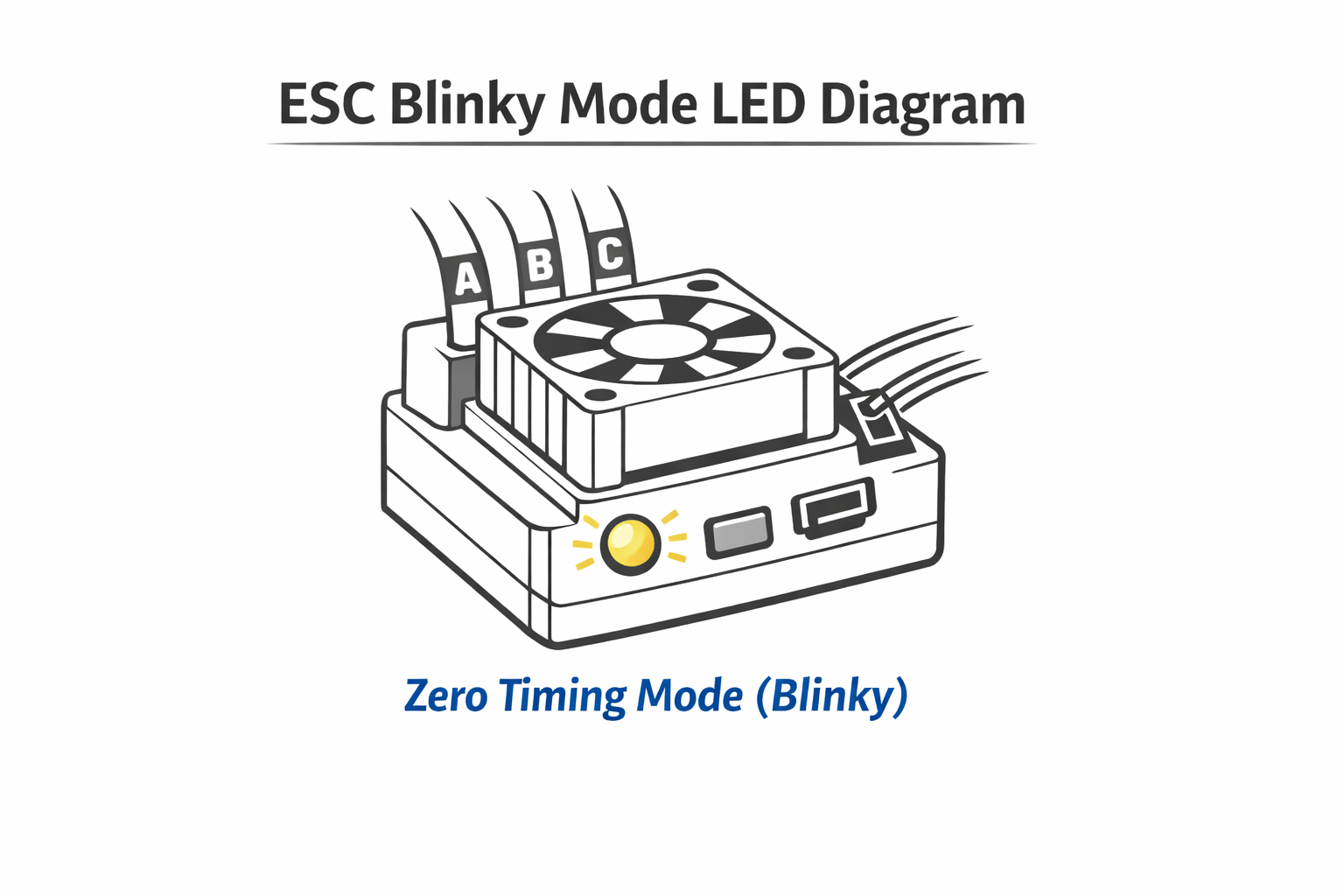
Key points:
- Blinky Mode = Zero Timing Mode — no electronic timing or boost.
- Flashing LED indicates the ESC is in legal stock configuration.
- Solid LED or colour‑change usually means timing or boost is active.
- Always check the LED before racing to verify compliance.
- Diagram reference: The yellow blinking LED shows the ESC operating correctly in Zero Timing Mode (Blinky).
Motor Types
17.5T (Stock Touring / Rally / Club Racing)
- Smooth power, low heat, ideal for beginners and club racing. Requires correct FDR to avoid bogging.
13.5T (Faster Stock Class)
- More RPM and heat. Needs careful gearing. Popular for faster club racing
10.5T / 8.5T / 6.5T (Modified)
- High RPM and heat. Requires boost/turbo. Not used in Blinky classes. Not recommended for TT‑02 or XV‑01.
Electronic Speed Controller (ESC)
An Electronic Speed Controller (ESC) regulates how much power flows from the battery to the motor. It provides proportional throttle control, braking, and protects the motor from overload.
Types of ESCs:
- Brushed ESC → for brushed motors (e.g., Hobbywing 1060).
- Brushless ESC → for brushless motors (e.g., Hobbywing Justock).
Blinky Mode: For stock racing, ESCs are run in Blinky Mode (zero timing advance). This ensures fair competition and keeps motors within safe temperature ranges.
Note in kit descriptions: When a kit says “ESC: not included”, you must supply your own ESC to run the motor.
ESC Settings (Blinky Mode)
- Boost: OFF
- Turbo: OFF
- Timing: 0° (ESC)
- PWM: 16–32 kHz
- Brake Strength: 80–100%
- Drag Brake: 0–5%
- Punch: Medium
Mechanical motor timing (on the motor can) is allowed and typically set between 30–40°.
Motor Timing Ring (Adjustable Endbell)
Brushless motors often feature an adjustable timing ring on the endbell. Rotating this ring changes the motor’s advance angle, directly affecting speed, torque, and heat.
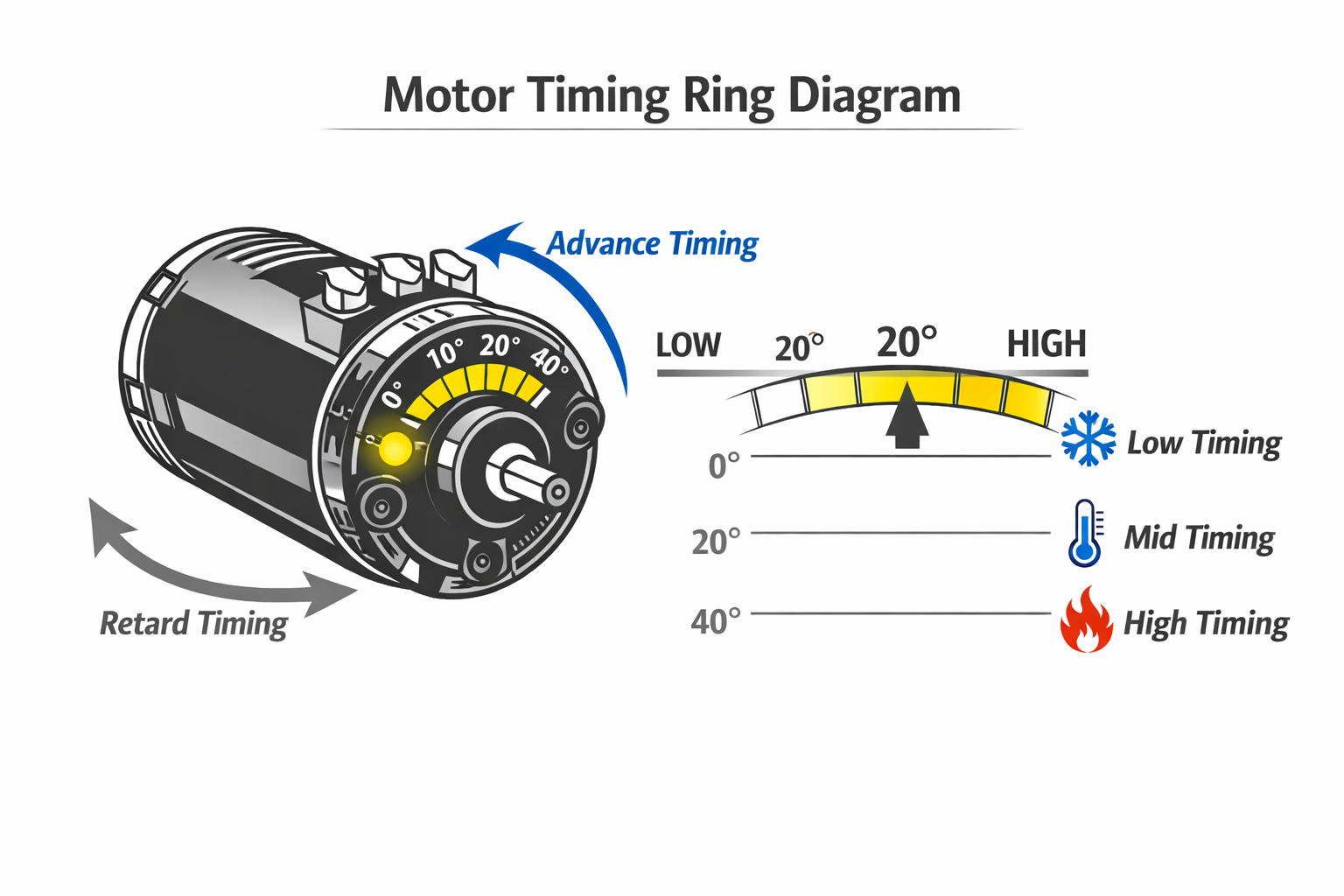
Key points:
- Low timing (0–20°) → cooler temps, more torque, less RPM.
- Mid timing (20–30°) → balanced torque and RPM, moderate heat.
- High timing (30°+) → maximum RPM, but higher heat and risk of overheating.
- Timing changes are mechanical, not electronic — they alter rotor/magnet alignment.
- Always check Motor Temperature Targets after adjusting timing.
Diagram reference: The highlighted ring shows the timing adjustment scale on the motor endbell. Arrows indicate rotation direction for increasing or decreasing timing.
Final Drive Ratio (FDR)
The Final Drive Ratio (FDR) describes how hard the motor works to turn the wheels. It combines the spur gear, pinion gear, and the car’s internal ratio.
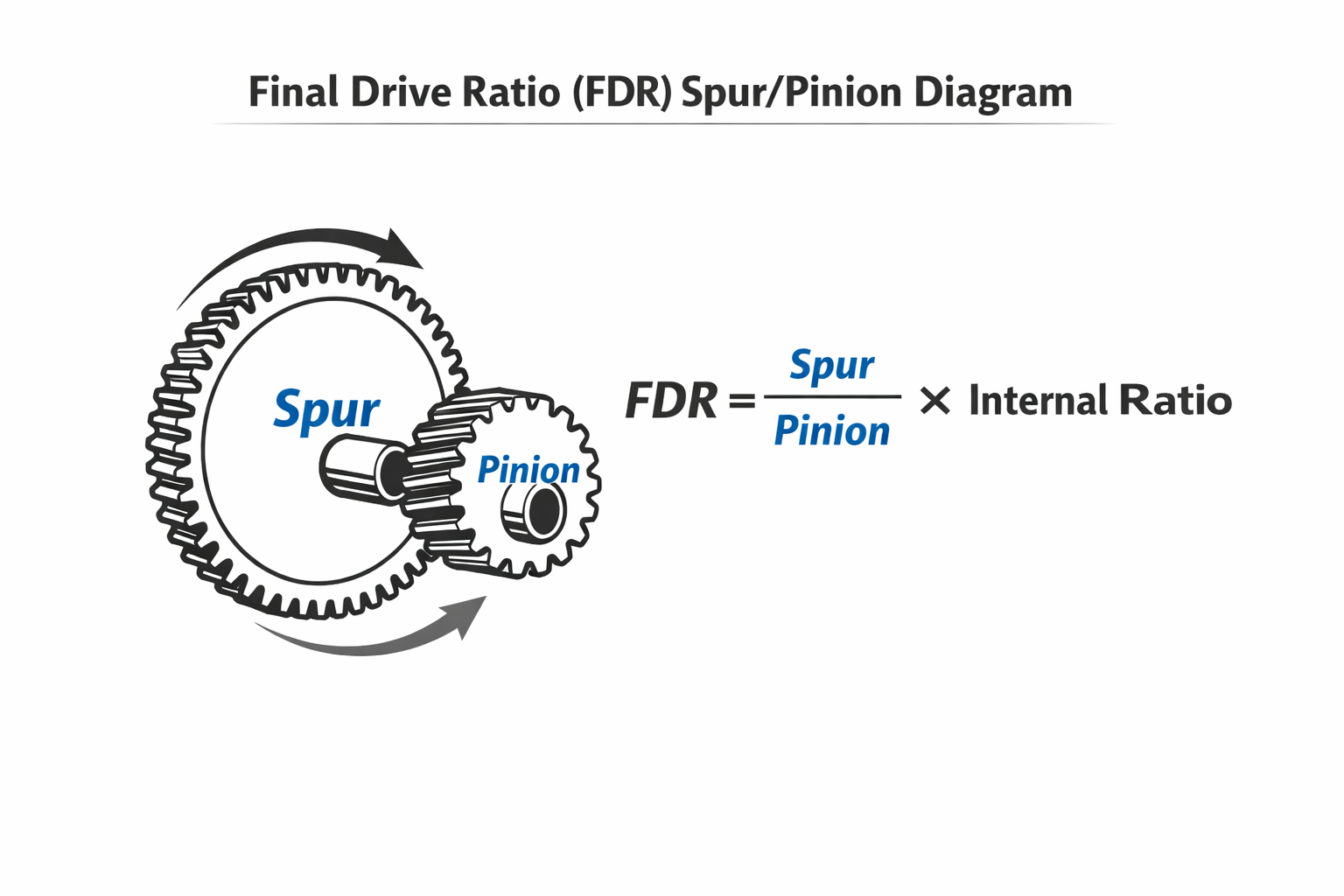
Key points:
- Formula: Spur ÷ Pinion × Internal Ratio.
- Lower FDR → more speed, less torque, higher motor load.
- Higher FDR → more torque, less speed, cooler motor.
- Spur/pinion changes are the quickest way to adjust FDR.
- Always check recommended FDR ranges for your chassis type.
Diagram reference: The spur and pinion gears show how gear choice affects the FDR calculation.
What is FDR (Final Drive Ratio)?
FDR is how hard the motor works to turn the wheels.
Higher FDR (bigger number): more torque, cooler motor, less top speed.
Lower FDR (smaller number): more top speed, hotter motor, more risk.
Formula: Spur ÷ Pinion × Internal Ratio.
Global FDR Ranges (By Motor Turn & Surface)
17.5T Blinky
- Carpet: 4.0–5.5
- Asphalt: 4.2–5.8
- Rally Tarmac: 5.0–5.5
- Rally Gravel: 5.5–6.0
13.5T Blinky
- Carpet: 5.0–7.0
- Asphalt: 5.2–7.2
- Rally Tarmac: 6.0–6.5
- Rally Gravel: 6.5–7.0
XV‑01 Example Gearing (17.5T Brushless)
- Stock spur: 68T (0.6 module)
- Rally / mixed gravel: 23T–24T pinion — punchy, cool temps, great control.
- Tarmac / fast asphalt: 25T–26T pinion — more top speed, still safe.
- One‑setup‑does‑everything: 68T spur + 24T pinion — the best all‑round gearing.
Motor Temperature Targets
Safe Range
- 60–75 °C → Ideal operating window for brushless stock motors.
- Keeps efficiency high and magnets stable.
Warning Range
- 80–90 °C → Risk of rotor demagnetisation begins.
- Action: increase FDR, reduce mechanical timing, improve cooling, or check drivetrain drag
Danger Zone
- 95 °C+ → Rotor magnets can permanently lose strength.
- Immediate action required: stop running, inspect gearing, cooling, and drivetrain.
Chassis‑Specific FDR Summary
TA‑08 (Touring Belt Car)
- 17.5T: 4.0–4.5 (carpet), 4.2–4.8 (asphalt)
- 13.5T: 5.0–5.5 (carpet), 5.2–5.8 (asphalt)
TT‑02 Touring
- 17.5T: 5.0–5.5 (carpet), 5.2–5.8 (asphalt)
- 13.5T: 6.0–7.0 (carpet), 6.2–7.2 (asphalt)
TT‑02 Rally
- 17.5T: 5.0–5.5 (tarmac), 5.5–6.0 (gravel)
- 13.5T: 6.0–6.5 (tarmac), 6.5–7.0 (gravel)
XV‑01 Rally
- 17.5T: 5.0–5.5 (tarmac), 5.5–6.0 (gravel)
- 13.5T: 6.0–6.5 (tarmac), 6.5–7.0 (gravel)
Cooling & Efficiency
- Use a 30mm motor fan
- Use a 40mm ESC fan for 13.5T
- Keep the motor clean
- Avoid over‑tight belts (TA‑08)
- Check bearings for drag
- Ensure wheels spin freely
Troubleshooting
Motor Overheating
- FDR too low, too much timing, drivetrain binding, fan failure.
Cogging / Stuttering
- FDR too high, weak battery, bad solder joints, sensor cable fault.
Low Top Speed
- FDR too high, ESC in wrong mode, motor timing too low.
Recommended Equipment
- Fans: 30mm motor
- 40mm ESC Pinions: 30–50T (touring)
- 20–35T (rally) Spurs: 64–96T depending on chassis